Tarot · 4 min read
A Beginner's Guide to Tarot: Where to Start When Everything Feels Overwhelming
If you've ever picked up a tarot deck, flipped through the cards, and felt a little lost, you're not alone. Seventy-eight cards, strange symbols, court...
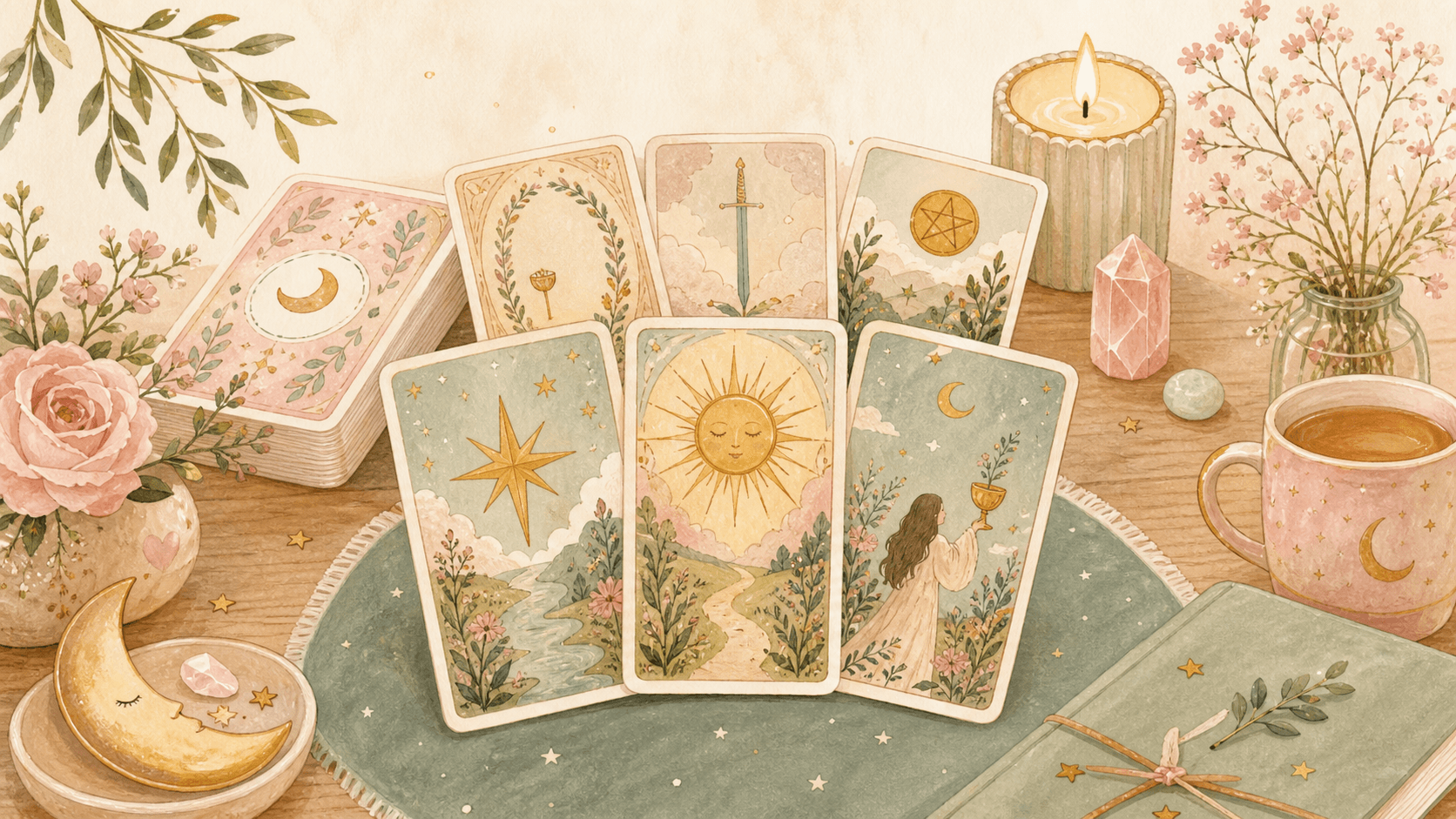
If you've ever picked up a tarot deck, flipped through the cards, and felt a little lost, you're not alone. Seventy-eight cards, strange symbols, court figures with titles like "Page of Swords" — it's a lot to take in at once. The good news is that you don't need to memorize any of it before you start. You just need a place to begin.
Pick a Deck That Feels Right
Most tarot decks trace back to one of two traditions. There's the older French-style deck, where only the 22 Major Arcana cards carry full illustrations and the rest are fairly simple, numbered suit cards. Then there's the Rider-Waite-Smith style, which illustrates every single card - all 78 of them - with scenes and symbols. For beginners, the second style is almost always the better starting point, because the pictures themselves teach you the meanings. Staring at a plain "Seven of Cups" with no imagery gives you nothing to work with, but seeing a figure surrounded by strange floating visions tells you something right away.
Beyond that, choose a deck that actually pulls you in. There are countless Rider-Waite-Smith-inspired decks now, from vintage-style reproductions to modern, inclusive reimaginings with diverse figures and contemporary imagery. And don't worry about the old superstition that a deck has to be gifted to you — that idea comes from a time when tarot decks weren't sold openly in stores. These days, buying your own is completely normal.
Understand the Basic Structure
Every tarot deck splits into two halves. The Major Arcana — 22 cards — represents the big stuff: turning points, life lessons, major themes that shape a person's story. The Minor Arcana, the remaining 56 cards, is about everyday life — the small decisions, moods, and situations we move through daily.
The Minor Arcana breaks down further into four suits, each tied to an element and a theme:
- Cups (Water) — emotions, relationships, love
- Pentacles (Earth) — money, career, physical health, material matters
- Swords (Air) — thoughts, communication, conflict, mental clarity
- Wands (Fire) — action, ambition, motivation, creative drive
Within each suit are the court cards — Page, Knight, Queen, and King. Rather than thinking of these as strictly male or female, it helps to think of them as representing stages of maturity and types of energy. A Page often signals someone new or inexperienced; a Knight carries impulsive, youthful energy; Queens and Kings represent mastery and stability, just expressed in different ways.
Learn a Simple Way to Read the Cards
You don't need to memorize a textbook's worth of meanings before doing your first reading. A great way to start is to simply pull a single card, look at the imagery, and ask yourself what you notice first. What's happening in the scene? How does it make you feel? Then connect that impression to whatever question or situation prompted the pull. A guidebook can fill in the traditional meaning afterward, but your first instinct matters just as much.
When you're ready to go beyond one card, try simple spreads. A three-card "past, present, future" spread is a classic starting point precisely because it's easy to follow. Save something like the ten-card Celtic Cross for later — untangling that many cards at once is a lot to handle before you're comfortable with the basics.
One more thing worth remembering: there's no such thing as a purely "bad" card. Even the Death card, which tends to spook newcomers, usually points to change and transformation rather than anything literal. Meaning in tarot depends heavily on context.
Keep Practicing
Like any skill, tarot gets easier the more you use it. Read for yourself, for friends, for anyone willing to let you practice. Keep notes on your readings so you can look back and see how accurate your interpretations turned out to be. Over time, you'll notice your intuition doing more of the work than memorized definitions — and that's really the whole point. The cards are less a fortune-telling machine and more a mirror, helping you notice things about a situation, or about yourself, that you already sensed but hadn't quite put into words.
There's no rush here. Tarot is something you get better at over years, not days, so give yourself room to be a beginner for a while. That's exactly where everyone starts.